

Many enterprises are trying to become AI-first by adding AI features. A copilot here. A chatbot there. An agent for one team. A forecasting tool for another. A summariser inside an existing dashboard.
Each of these may be useful. But together, they do not necessarily transform the enterprise.
In this fourth The Scarlet Letter I reflect on how enterprises should evaluate the desire of quickly adding AI features vs actually rerouting their platform into being an AI first product.
The real question is not: where can we add AI? A more useful question is: What must become reusable, connected and governable for AI to operate across the enterprise? This is where the conversation changes.
Reasons to read
AI features are designed fast, often sit on top of the old organisation: old data structures, old approval chains, old workflows, old permissions, old reports, old habits, old silos. This is the mistake many companies will now make with AI. They will add intelligence as a feature, instead of redesigning the enterprise so intelligence can move through it.
The real question is not: where can we add AI? A more useful question is: What must become reusable, connected and governable for AI to operate across the enterprise? This is where the conversation changes.
An AI-first enterprise is not one that has AI in every product or every department. It is an enterprise where data, workflows, decisions, knowledge, approvals, rules, people and systems can be connected in a way that intelligence can use. This is what it means to become a platform for intelligence. Not a company with many AI features. A company whose operating system is AI ready.
What it means to become a platform for intelligence and not an enterprise with many AI features — an enterprise whose operating system is AI ready.
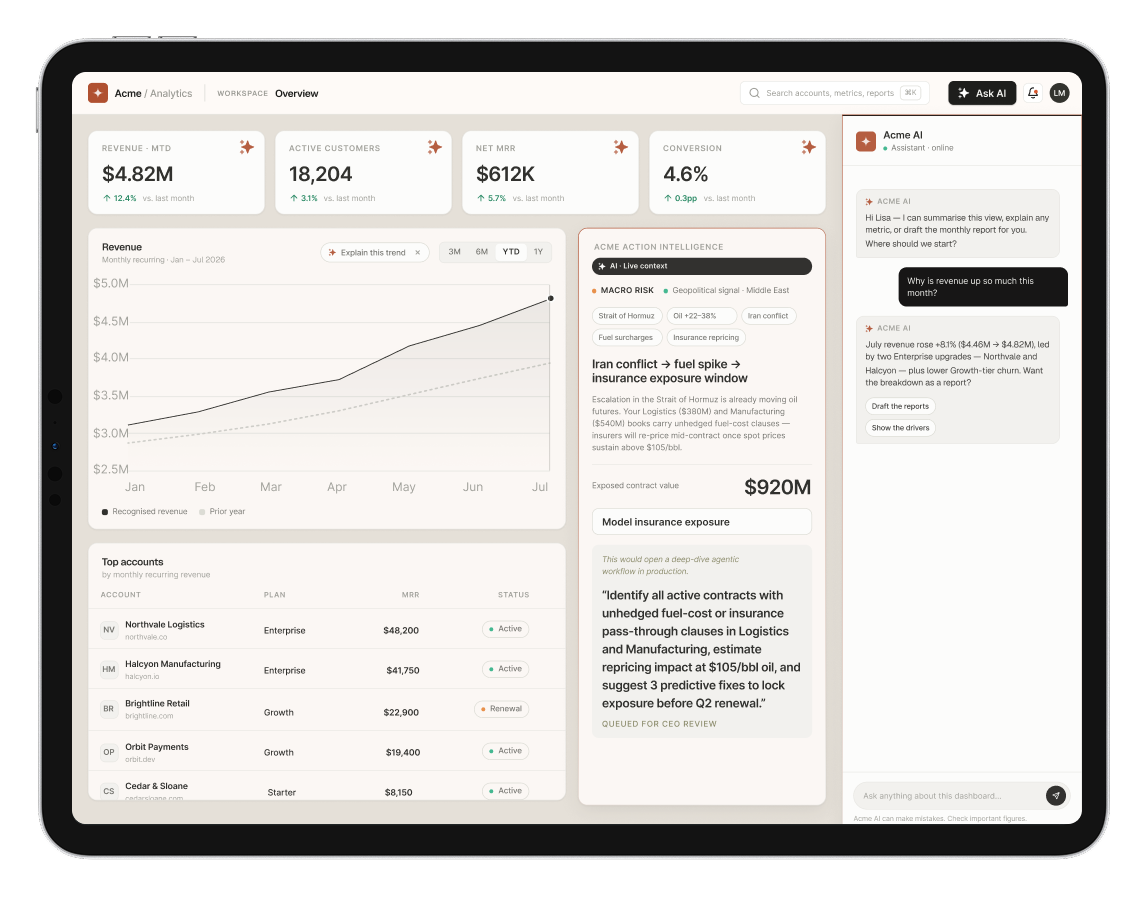
AI-first shouldn't mean AI-everywhere
Most enterprise software helps people complete tasks. This is where the difference becomes simple. A traditional enterprise system helps people do work. It records information, moves a request from one stage to another, creates a ticket, stores a document, shows a dashboard, asks a user to approve, reject, upload, assign or close.
If people are well trained, this works smoothly. But the intelligence is still mostly outside the system. It sits in experienced employees, in training manuals, in standard playbooks, in managers’ judgment, in spreadsheets, in long email threads. It sits in the memory of people who know “how things actually get done”.
AI changes the ambition.
An AI-enabled enterprise system should not only help people complete tasks. It should help the organisation understand what is happening, what is stuck, what is likely to go wrong, what should happen next, who should act, and what needs to be governed. That is a different kind of enterprise.
AI-first does not mean AI-everywhere.
AI-everywhere is easy to imagine and dangerous to execute. It leads to scattered experiments. One team builds a sales assistant. Another builds an HR bot. Another builds a finance summariser. Another builds a service agent. Each one has its own data, permissions, rules, workflows and reporting.
This may look like progress for a while. But if every AI use case needs its own data model, its own logic, its own approval process, its own security layer and its own governance, the company is not transforming. It is creating new silos.
An AI-enabled enterprise system should not only help people complete tasks. It should help the organisation understand what is happening, what is stuck, what is likely to go wrong, what should happen next, who should act, and what needs to be governed. That is a different kind of enterprise.
A shift from features to platform
The better question for leadership is not: What are our top 20 AI use cases?
It is: What shared capabilities must we build so that 20, 50 or 100 AI use cases can be created safely, quickly and repeatedly?
That is the shift from features to platform.
Use cases are outputs. Platform capability is leverage.
A use case solves one problem. A platform capability can solve many.
A customer identity layer can power sales, service, support, onboarding, risk and retention. A document intelligence layer can power contracts, claims, compliance, procurement, audit and knowledge search.
A workflow layer can power approvals, exceptions, escalations, handoffs and follow-ups. A policy layer can power governance, risk checks, eligibility, permissions and compliance.
An audit layer can power trust, accountability, review and regulatory reporting.
This is why CXOs need to look beneath the use case.
The real transformation is not the chatbot, agent or dashboard that users see. The real transformation is the common platform underneath: the data, rules, workflows, permissions, knowledge, feedback loops and governance that allow intelligence to operate across the company.
The enterprise must become easier for AI to understand. Many companies are not yet ready for AI because the enterprise itself is difficult to read.
The real transformation is the common platform underneath: the data, rules, workflows, permissions, knowledge, feedback loops and governance that allow intelligence to operate across the company. The enterprise must become easier for AI to understand.
The work before AI is not glamorous
The company must make its knowledge usable, workflows visible, decisions traceable, permissions clear, data connected, rules reusable, exceptions learnable. Easier said than done, I agree, but it's foundational.
This is not back-office plumbing. This is the foundation of an AI-first enterprise. Most enterprise systems were built to record work. AI-enabled platforms must help improve work.
It should also help answer: Why is this delayed? What is likely to fail? What decision is needed? What rule applies here? What has happened in similar cases before? Who needs to intervene? What should be automated? What should remain human-led? What must be reviewed later?
This is where AI becomes meaningful.
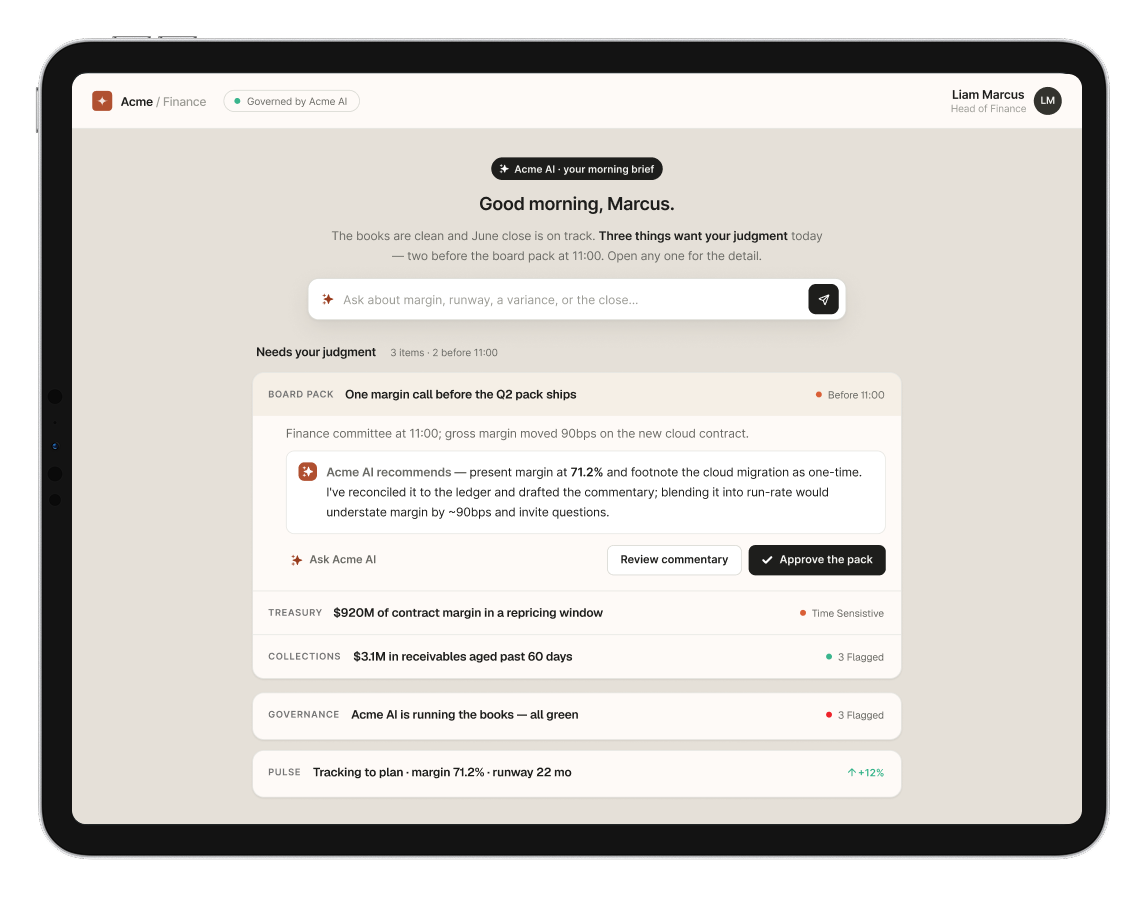
Design has a serious role here
This is where design must enter the conversation again. Because an AI-first enterprise is not only a technology problem. It is an experience, governance and decision-design problem.
What should AI show? What should it hide? What should it suggest? What should it automate? What should it ask permission for? What should it explain? What should it remember? What should it forget? What should be reversible? What should be auditable?
These are not small interface questions. They decide how much control people have, how trust is built, where human judgment remains essential. They decide how safely AI can be used inside complex organisations.
The future enterprise interface will not only be a chatbot. It will be a set of control surfaces: places where people can inspect, approve, correct, redirect, compare, simulate and govern intelligent work.
The CXO’s job is to create the conditions for intelligence. A CXO does not need to personally choose every AI use case. The more important CXO responsibility is to create the conditions in which AI can work responsibly across the enterprise.
I am Lisa Rath
I lead the product design team at ICD and work with enterprises building AI-enabled systems across functions. This is what I am observing as organisations move from experimentation to scale, and what will begin to define how AI is actually used, not just adopted.